

- October 8, 2025
- Posted by: admin
- Category: Zero Liquid Discharge
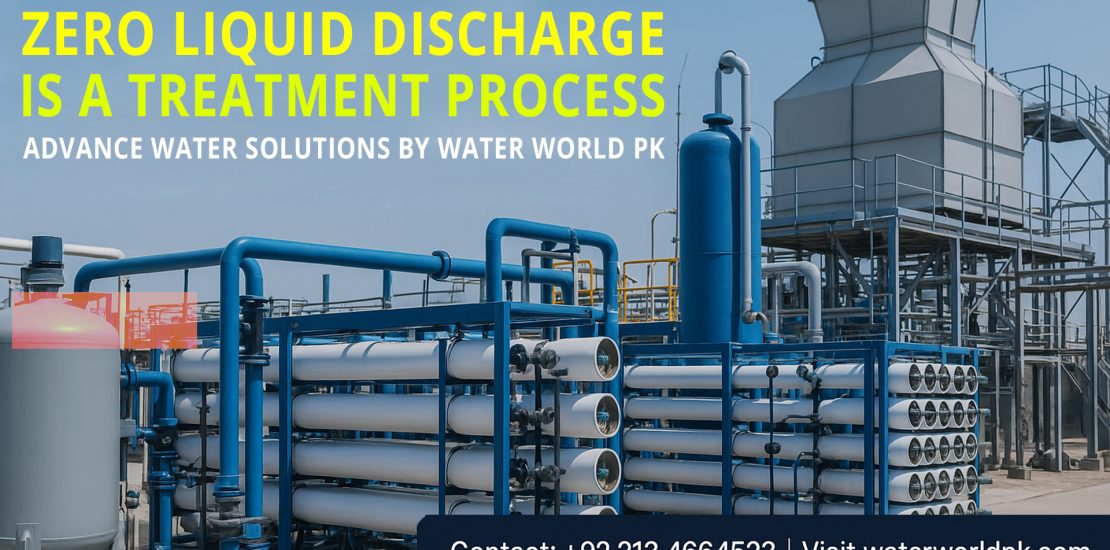
♻️ From waste to value: how ZLD actually works in Pakistan (and when you should use it)
Water is tight. Regulations are tighter. If your site must stop all liquid discharge, Zero Liquid Discharge Is A Treatment Process that recovers usable water, concentrates brine, and leaves solids you can handle safely. At Water World PK, we design ZLD systems that fit real plants — textile, chemical, pharma, power — not just textbook diagrams.
Start with our service page if you want the short version: Zero Liquid Discharge (ZLD). If your wastewater also includes process effluent, skim Effluent Treatment Plants and Industrial Wastewater Treatment Services for context. Need polishing steps? You’ll touch Ultrafiltration and Industrial RO Plant on day one.
What ZLD means in plain terms
When we say Zero Liquid Discharge Is A Treatment Process, we mean a complete train that:
- treats wastewater, 2) recovers clean water for reuse, 3) concentrates the rest into solids (salt/cake) — so no liquid leaves your site.
Where it shines in Pakistan:
- Textile & dyeing (export buyers ask for water recovery) → see Textile Effluent Recycling
- Chemical & pharma (tight limits, mixed contaminants)
- Power & boiler makeup (stable reuse water helps OPEX)
- Industrial estates with shared ETPs that need to eliminate discharge entirely
ZLD process — the moving parts (Pakistan-ready)
Below is a simple, copy-paste HTML table you can drop into your page:
ZLD Process Flow — From Inlet to Solids
| Stage | What Happens | Typical Equipment | Learn More |
| Pretreatment | Remove oils/solids, balance pH, knock down COD for membranes. | Equalization, aeration (SSI diffusers/blowers), coagulation/flocculation | SSI Aeration · ETP Basics |
| Membrane Polishing | Clarify and polish before desalination; protect RO. | Ultrafiltration (UF), multimedia filters, cartridges | Ultrafiltration |
| RO Desalination | Recover permeate for reuse; send brine forward. | High-pressure RO skids, FRP vessels, dosing/antiscalant | Industrial RO |
| Brine Management | Concentrate RO reject until only solids remain. | Evaporator (often MVR), crystallizer, centrifuge, dryers | ZLD Overview |
| Condensate Polishing | Clean evaporator condensate for reuse. | Polishing filters, activated carbon, final disinfection | Water Recycling |
Design choices that matter in Pakistan
- Scaling control: Real brines scale fast. Get dosing right and keep cleaning in the plan (UF/RO CIP windows).
- Aeration quality: Good pretreatment saves membranes later — solid SSI diffusers & blowers help drop COD early.
- Power math: Thermal steps (evaporator/crystallizer) drive OPEX. Improve recovery before thermal, not after.
- Operator reality: Simple routines win. If your team can’t maintain it, it won’t stay ZLD for long.
- Integration: STP on campus? Coordinate reuse targets with Municipal & Industrial Wastewater planning.
When ZLD is the right call (and when it’s not)
Choose ZLD when:
- Regulations or brand commitments require no liquid discharge.
- Water reuse has strong value on site.
- Waste salts can be handled responsibly.
Consider high-recovery reuse (RO/UF + good ETP) instead of full ZLD when:
- Your discharge path is compliant and sustainable.
- Thermal OPEX would crush your budget.
If you’re weighing options, we’ll run both cases with you.
What it takes to run ZLD well (day 2 and day 200)
- Keep pretreatment honest. Don’t send unstable chemistry to RO.
- Watch SDI, pH, and antiscalant like a hawk.
- Schedule CIP — don’t wait for a crisis.
- Track energy, chemical cost, and salt cake handling monthly.
Need a service partner? Tap ETP Services in Pakistan for audits, CIPs, and AMC.
FAQs — fast answers
Is ZLD mandatory for every plant?
No. It’s for sites that must eliminate discharge or want maximum reuse. We also design high-recovery non-ZLD systems.
Can we phase into ZLD?
Yes. Start with strong ETP + Ultrafiltration + RO. Add evaporator/crystallizer later.
What’s the biggest reason ZLD underperforms?
Weak pretreatment and skipped maintenance. Fix the front end and keep CIPs on schedule.
Do you supply and install everything?
Yes — design, equipment, installation, automation, and O&M. See Zero Liquid Discharge (ZLD).
Conclusion
If you’re aiming for no liquid discharge without crippling OPEX, build ZLD like a ladder: solid ETP and membranes first, thermal steps only as big as they need to be. Zero Liquid Discharge Is A Treatment Process — but it’s also a discipline. Done right, you recover water, keep regulators calm, and turn a waste line into a resource.
Tell us your flow, feed analysis, and reuse target. We’ll share a practical ZLD plan with staged CAPEX, OPEX math, and an install timeline.
Start here: Zero Liquid Discharge (ZLD) • Need pretreatment guidance first? Effluent Treatment Plants