

- September 6, 2026
- Posted by: Arfah
- Category: Blogs

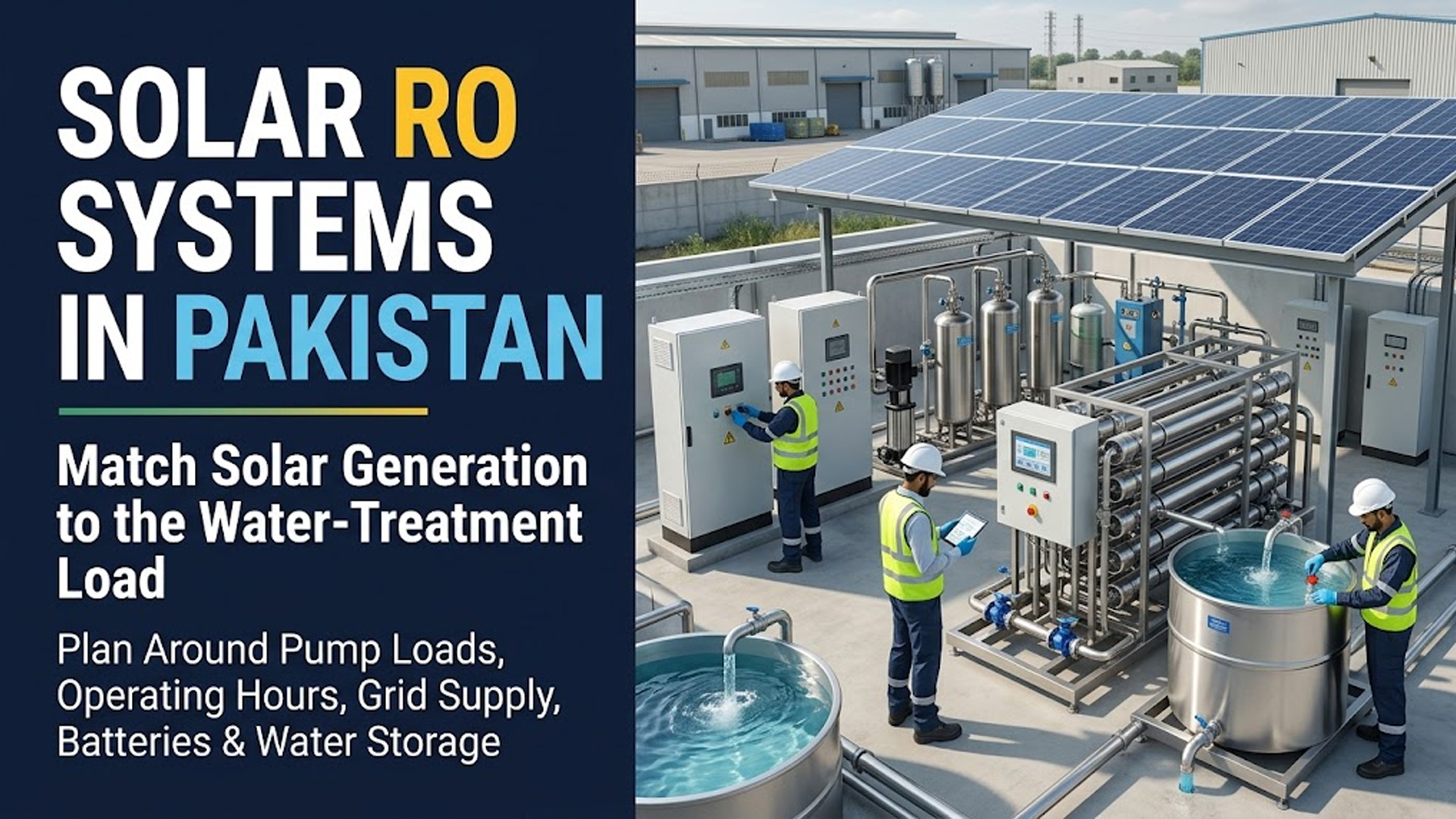
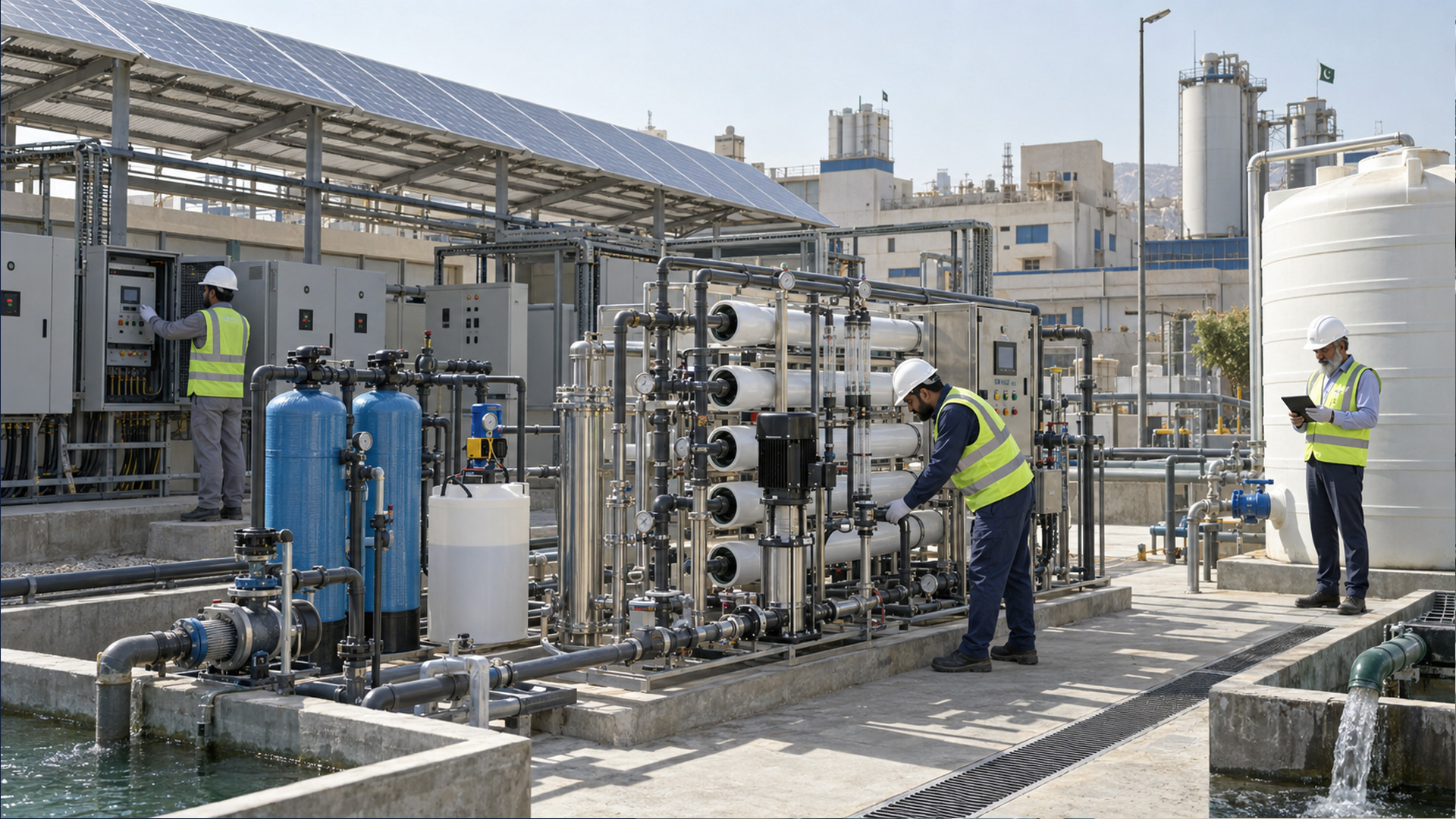 Adding solar panels to an RO project does not automatically create a well-designed solar water-treatment system. The electrical load, operating schedule, water demand and storage strategy have to work together.
Industrial and commercial facilities considering solar for reverse osmosis often begin with a simple question: how many solar panels are needed to run the RO plant?
That question comes too early.
An RO installation contains several electrical loads, including feed pumps, high-pressure pumps, pretreatment equipment, dosing systems, controls and sometimes post-treatment or distribution pumps. These loads operate according to water demand, while solar generation changes through the day.
Direct answer: A solar RO system in Pakistan should be planned from the complete electrical load profile, required daily water production, RO operating hours, solar-generation window, grid availability, pumping requirements and water-storage strategy. Depending on the project, the appropriate solution may be grid-connected solar support, a hybrid system or another configuration rather than trying to operate every water-treatment load directly from solar generation alone.
Solar and RO Have Different Operating Profiles
An RO plant produces water when it is operated.
Solar photovoltaic generation changes with sunlight and site conditions.
The engineering challenge is therefore to decide how those two profiles should interact.
Questions include:
- Does the RO need to operate continuously?
- Can most production occur during daylight?
- Is grid electricity available?
- Is battery storage being considered?
- Can treated-water storage shift production away from peak demand?
- Are pumps required outside solar-generation hours?
Start with Required Water Production
The water-treatment requirement should remain the first design input.
Define:
- Required treated-water volume per day
- Peak water demand
- Operating hours
- Source-water condition
- RO recovery
- Storage requirement
- Distribution demand
Only after the water-production requirement is clear should the electrical load be matched to a solar strategy.
WWI’s Industrial RO Plant page remains the main commercial owner for industrial reverse-osmosis equipment.
Identify Every Electrical Load in the Treatment Train
The RO high-pressure pump is important, but it may not be the only significant electrical load.
| Equipment | Load-Planning Consideration |
|---|---|
| Raw-water pump | May run during RO production or tank filling |
| Pretreatment pumps | Depend on treatment arrangement |
| High-pressure RO pump | Usually a major continuous load during RO operation |
| Chemical dosing | Smaller load but required during treatment |
| Controls and instrumentation | Require reliable power for operation and protection |
| Backwash/CIP equipment | May create intermittent additional demand |
| Treated-water distribution pumps | May operate on a different schedule from the RO plant |
Running Power and Starting Conditions Are Different
Electric motors can create different electrical conditions during starting than during normal operation.
The system design should therefore consider:
- Motor starting method
- Inverter compatibility
- Variable-frequency drives where used
- Simultaneous equipment starting
- Protection arrangements
A solar or hybrid electrical design should be checked against actual equipment data rather than based only on average kWh consumption.
Solar Generation Is Not Constant Through the Day
PV output varies with solar irradiance, temperature, shading, orientation, system losses and other site conditions.
This means an RO system that requires a stable electrical supply should not be sized around a single headline solar-array rating.
The design should evaluate expected generation across the operating period.
Grid-Connected Solar Can Offset Part of the RO Load
Where a reliable grid connection is available, solar can be integrated into the wider facility electrical system rather than being dedicated exclusively to the RO plant.
During solar-generation hours, part of the treatment load may be supplied by onsite generation while the electrical system manages the overall balance.
This can be simpler than designing the RO process to start and stop according to instantaneous solar output.
Hybrid Systems Add Another Layer of Control
A hybrid arrangement may combine solar generation with grid supply, batteries or another power source.
The correct configuration depends on the project.
Important questions include:
- How reliable is grid supply?
- Which water-treatment loads are critical?
- How much autonomy is required?
- Can water storage provide operational flexibility?
- Is electrical storage economically justified?
Water Storage Can Sometimes Reduce the Need for Electrical Storage
Water treatment projects have an operational advantage that some other electrical loads do not: treated water can often be stored.
If the project allows the RO system to produce more water during strong solar-generation hours, a treated-water tank may help satisfy demand later without requiring the treatment plant itself to operate continuously.
This does not eliminate the need for electrical engineering, but it can change the relationship between energy generation and water demand.
Do Not Oversize RO Merely to Chase Daylight Hours
Increasing RO production capacity so the plant can run for fewer hours may appear attractive in a solar-supported project.
However, this affects:
- Capital cost
- High-pressure pump size
- Membrane area
- Pretreatment flow
- Peak electrical demand
- Tank sizing
The system should therefore be optimized across both water and energy requirements.
Feed-Water Quality Still Controls RO Design
Solar integration does not change the fundamental water-treatment requirement.
The source water should still be evaluated for parameters relevant to RO design, including:
- TDS
- Hardness
- Turbidity
- Iron where relevant
- Silica where relevant
- Microbiological conditions
- Other source-specific constituents
A poorly pretreated RO plant will not perform better simply because it is supplied by solar energy.
Pretreatment Loads Must Be Included in Solar Planning
Some pretreatment systems operate intermittently.
Backwashing, regeneration, dosing or membrane cleaning can create loads outside normal RO production.
These activities should be included in the overall electrical and operational schedule.
RO Recovery Affects Both Water and Energy Planning
Recovery influences the amount of feed water required to produce a given volume of permeate.
However, recovery should remain compatible with water chemistry and membrane design.
It should not be increased solely to reduce pumping time or energy use without considering scaling and concentrate conditions.
Reject Water Needs a Defined Route
Solar-supported RO still produces a concentrate stream.
The project should define:
- Concentrate quantity
- Concentrate quality
- Discharge or handling route
- Whether additional recovery is justified
Where very high recovery is being considered, the design may need to connect with a broader Zero Liquid Discharge strategy rather than simply increasing RO recovery.
Industrial Plants May Have Better Load-Matching Opportunities
An industrial facility may already operate significant electrical equipment during daylight hours.
Solar generation can therefore be assessed as part of the complete facility load rather than only against the RO skid.
This wider approach may be relevant when pumps, compressors, HVAC, process equipment and water treatment operate concurrently.
Remote Sites Need a Different Solar Strategy
A remote water-treatment project may have limited or unreliable grid access.
In that situation, electrical design becomes more closely connected to:
- Solar generation
- Battery storage where required
- Backup generation
- Water storage
- Operating hours
- Critical-load prioritization
The final arrangement should clearly define what happens during extended low-generation periods.
Containerized RO Can Be Considered for Selected Remote Projects
Where transportability and site construction are important, a Containerized RO Plant may be evaluated as part of the project.
Containerization can simplify some aspects of equipment packaging, but the site still requires appropriate feed water, drainage, electrical connection, access and operating arrangements.
Solar Equipment Should Be Designed Around the Actual Installation Environment
Project planning should consider:
- Available roof or ground area
- Shading
- Equipment access
- Environmental exposure
- Cable routes
- Inverter location
- Maintenance access
- Future expansion
Monitoring Should Connect Water and Energy Performance
A solar-supported RO project becomes easier to manage when operators can see both sides of performance.
Useful data can include:
- RO water production
- Feed and permeate conductivity
- Operating pressure
- Electrical consumption
- Solar generation
- Plant operating hours
- Tank level
- Fault and shutdown history
This makes it easier to determine whether poor water production comes from the treatment plant, electrical supply or changing water demand.
Questions to Answer Before Requesting a Solar RO Proposal
- How much treated water is required each day?
- What is the source-water analysis?
- How many hours can the RO operate?
- Is grid electricity available?
- What is the site’s current electrical load?
- Is battery storage required?
- How much treated-water storage is available?
- What roof or ground area is available for solar?
- Are there critical loads that require continuous power?
- What future expansion is expected?
Solar Should Support the Water-Treatment Strategy, Not Complicate It
A well-planned solar RO system in Pakistan connects the required water-production profile with a realistic electrical strategy.
The strongest project may use solar to offset grid consumption, may shift RO operation toward solar-generation hours, or may combine generation and storage where the site requires greater independence.
The correct answer depends on both water engineering and electrical engineering.
WWI’s Manufacturing and Engineering Services page provides the broader engineering route for enquiries involving integrated electrical, solar and RO requirements.
Request a Solar RO Project Review
Provide your daily water demand, source-water analysis, required RO capacity, site electrical information and available solar area. Water World International can review the project inputs needed before the treatment and energy configuration is finalized.
Frequently Asked Questions
Can an RO plant run on solar power?
Yes, solar can support an RO plant, but the electrical configuration depends on the treatment load, operating schedule, site generation profile, grid availability and whether storage or backup power is required.
Does a solar RO system need batteries?
Not always. Battery requirements depend on whether the plant must operate when solar generation is unavailable and whether grid or other backup power is available.
Can water storage reduce battery requirements?
In some projects, producing and storing treated water during strong solar-generation periods can reduce the need to operate the RO plant continuously. The feasibility depends on water demand and storage capacity.
What is the biggest electrical load in an RO plant?
The high-pressure pump is commonly a significant load, but the complete project should also include feed pumps, pretreatment, controls, cleaning and distribution equipment.
Does solar power change RO pretreatment requirements?
No. Pretreatment is still selected according to feed-water quality and membrane requirements. Solar changes the energy-supply strategy, not the underlying water chemistry.